
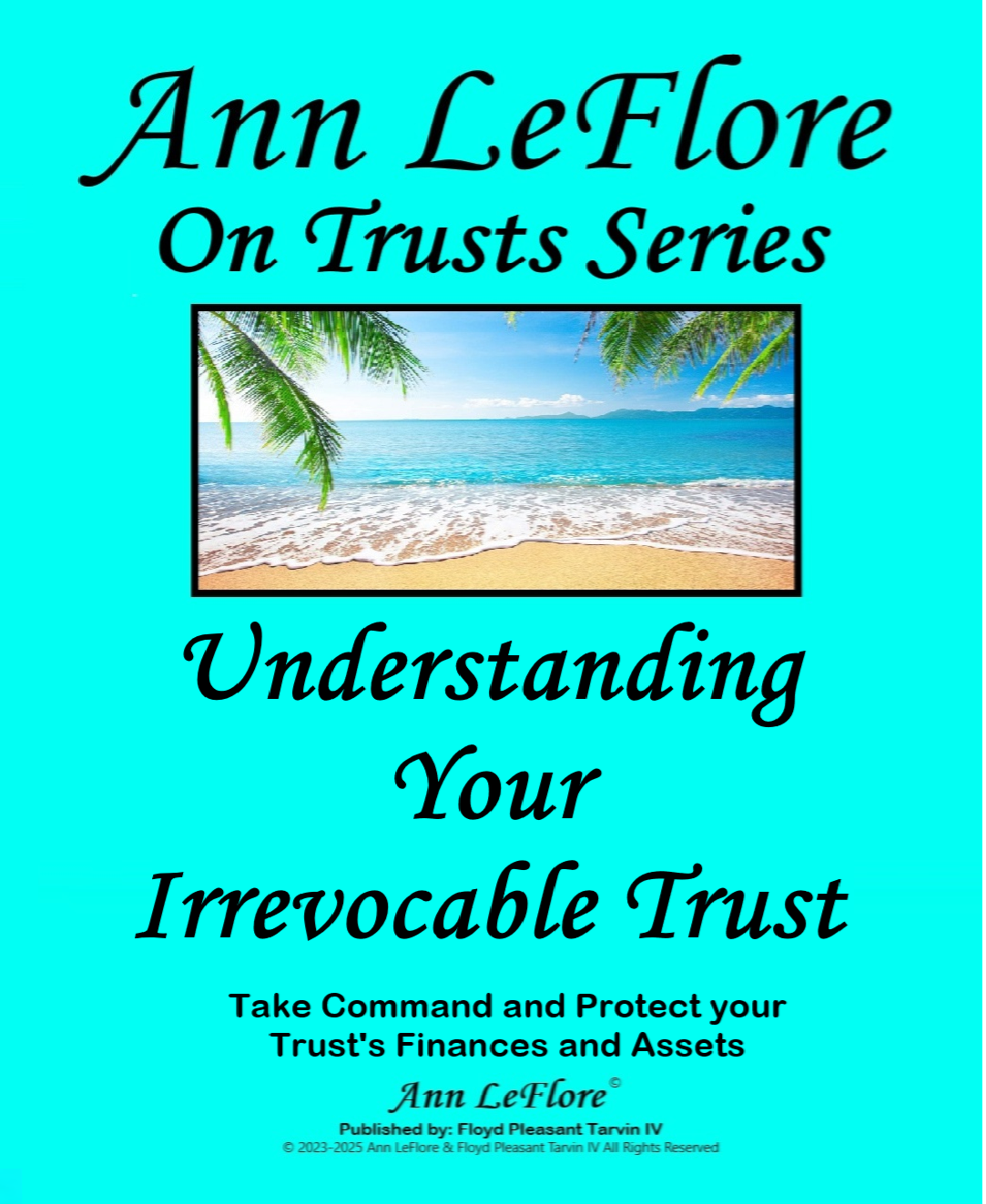
Understanding your Irrevocable Trust – eBook, Softcover or eBook & Softcover
$49.95 – $99.95Price range: $49.95 through $99.95
An Irrevocable Trust is a trust that generally cannot be changed, amended, or revoked once it has been created and funded. The assets placed into the trust are managed by the trustee according to the terms of the trust agreement for the benefit of the named beneficiaries. This type of trust separates the ownership of the assets from the individual who created the trust.
Available as an eBook, Softcover, or eBook + Softcover combination.
Description
Understanding your Irrevocable Trust
What Will You Learn?
-
What an irrevocable trust is and how it differs from other types of trusts.
-
How an irrevocable trust is created, structured, and legally established through a trust agreement.
-
How assets such as real estate, bank accounts, investments, and personal property can be transferred into the trust.
-
The roles and responsibilities of the grantor, trustee, and beneficiaries within an irrevocable trust.
-
How trustees manage, control, and administer trust assets according to the terms of the trust document.
-
How distributions are made to beneficiaries based on the rules and instructions written in the trust agreement.
-
How irrevocable trusts can be used for long-term estate and asset management planning.
-
How trust assets are separated from personal ownership and managed independently by the trustee.
-
How proper trust administration, recordkeeping, and documentation are maintained.
-
How different provisions such as spendthrift clauses and trustee powers are written into a trust agreement.
-
How an irrevocable trust can be structured to operate for a specific purpose or for long-term family planning.
-
How trust schedules, assignments, and supporting documents are used to fund and operate the trust properly.
-
How trustees handle investments, income, and expenses related to trust assets.
-
How sample trust agreements and templates can help readers understand the structure and operation of an irrevocable trust.
Book Description
An irrevocable trust is a legal trust structure designed to hold and manage assets according to the terms written in a formal trust agreement. Once the trust is created and funded, the assets placed into the trust are no longer owned directly by the individual who created it. Instead, those assets are managed by a trustee for the benefit of the named beneficiaries according to the rules and instructions established in the trust document.
This book explains how irrevocable trusts are structured, how they operate, and how they are used in long-term trust planning. Readers will learn how a trust agreement is written, how trustees administer trust property, and how assets are transferred into the trust through proper funding. The book also explains the responsibilities of the grantor, trustee, and beneficiaries, and how each role functions within the trust structure.
In addition to explaining the legal framework, this guide provides practical examples of trust documents and provisions used in irrevocable trust agreements. It walks through the key components of a trust, including trustee powers, distribution provisions, spendthrift protections, and administrative procedures that allow the trust to function properly over time.
By combining clear explanations with real trust examples and templates, this book serves as a practical reference for understanding irrevocable trusts. It helps readers see how these trusts are created, funded, and administered while providing the foundational knowledge needed to understand how irrevocable trust structures operate.
Books Details
Author: Ann LeFlore
Pages: 230
Format: eBook and/or Softcover
Category: Trust Administration
Understanding your Irrevocable Trust
What Will You Learn?
What an irrevocable trust is and how it differs from other types of trusts.
How an irrevocable trust is created, structured, and legally established through a trust agreement.
How assets such as real estate, bank accounts, investments, and personal property can be transferred into the trust.
The roles and responsibilities of the grantor, trustee, and beneficiaries within an irrevocable trust.
How trustees manage, control, and administer trust assets according to the terms of the trust document.
How distributions are made to beneficiaries based on the rules and instructions written in the trust agreement.
How irrevocable trusts can be used for long-term estate and asset management planning.
How trust assets are separated from personal ownership and managed independently by the trustee.
How proper trust administration, recordkeeping, and documentation are maintained.
How different provisions such as spendthrift clauses and trustee powers are written into a trust agreement.
How an irrevocable trust can be structured to operate for a specific purpose or for long-term family planning.
How trust schedules, assignments, and supporting documents are used to fund and operate the trust properly.
How trustees handle investments, income, and expenses related to trust assets.
How sample trust agreements and templates can help readers understand the structure and operation of an irrevocable trust.
Book Description
An irrevocable trust is a legal trust structure designed to hold and manage assets according to the terms written in a formal trust agreement. Once the trust is created and funded, the assets placed into the trust are no longer owned directly by the individual who created it. Instead, those assets are managed by a trustee for the benefit of the named beneficiaries according to the rules and instructions established in the trust document.
This book explains how irrevocable trusts are structured, how they operate, and how they are used in long-term trust planning. Readers will learn how a trust agreement is written, how trustees administer trust property, and how assets are transferred into the trust through proper funding. The book also explains the responsibilities of the grantor, trustee, and beneficiaries, and how each role functions within the trust structure.
In addition to explaining the legal framework, this guide provides practical examples of trust documents and provisions used in irrevocable trust agreements. It walks through the key components of a trust, including trustee powers, distribution provisions, spendthrift protections, and administrative procedures that allow the trust to function properly over time.
By combining clear explanations with real trust examples and templates, this book serves as a practical reference for understanding irrevocable trusts. It helps readers see how these trusts are created, funded, and administered while providing the foundational knowledge needed to understand how irrevocable trust structures operate.
Books Details
Author: Ann LeFlore
Pages: 230
Format: eBook and/or Softcover
Category: Trust Administration
Table of Contents
Glossary of Terms. 19
INTRODUCTION.. 23
Chapter 1. 24
What “Irrevocable” Means in Law (Not Marketing) 24
Part I: The Term “Irrevocable Trust” as a Misused Legal Classification. 25
Irrevocability as Classification, Not Permanence. 25
How the Term Is Commonly Used Outside Legal Analysis. 26
The Legal Meaning of Irrevocability. 27
Divergent Institutional Frameworks: IRS Analysis Versus Judicial Analysis. 29
Mapping Misconceptions to the Operative Legal Questions. 31
Questions Commonly Asked—and Why They Are Legally Misframed. 33
Practitioner Method: How Lawyers Evaluate “Irrevocable” Trust Risk. 34
Judicial Treatment in Contested Proceedings. 36
Part II: How Marketing Language Diverged from Court Language. 38
Distinct Institutional Functions. 38
Compression Versus Decomposition. 39
The Illusion of Consistency Created by Shared Vocabulary. 40
Assumed Compliance Versus Tested Compliance. 41
Intent Versus Effect 42
Risk Discounting in Transactional Contexts. 43
Consequences of the Divergence. 44
The Limits of Reconciliation. 45
Part III: Why Judges, the IRS, and Creditors Do Not Read Trust Brochures. 46
Judicial Analysis: Adjudication, Not Validation. 47
IRS Analysis: Tax Characterization, Not Formal Classification. 48
Creditor Analysis: Recoverability, Not Intent 49
The Common Analytical Framework. 50
Consequences of Relying on Promotional Descriptions. 51
Part IV: Court Authority Over Irrevocable Trusts. 52
The Source of Judicial Authority Over Trusts. 53
Irrevocability Does Not Limit Subject-Matter Jurisdiction. 54
Statutory Authority to Modify or Terminate Irrevocable Trusts. 54
Equitable Powers Over Irrevocable Trusts. 55
Disregard and Recharacterization. 57
Public Policy Constraints on Trust Enforcement 58
The Practical Effect of Court Authority. 59
Chapter 2: Why Irrevocability Does Not Place Assets Beyond Reach. 61
Part I: Separation as a Legal Requirement, Not a Label 61
The Legal Meaning of Separation. 62
Control as the Primary Failure Point 63
Beneficial Enjoyment and Economic Access. 64
Part II: Creditor Reach and Debtor–Trust Relationships. 65
Self-Settled Trusts and Creditor Access. 66
Fraudulent Transfer and Timing Analysis. 66
Spendthrift Provisions and Their Limits. 67
Part III: IRS Reach and Tax Inclusion. 68
Estate Tax Inclusion Despite Irrevocability. 68
Income Tax Attribution. 69
Gift Tax Recharacterization. 69
Part IV: Structural and Operational Failures. 70
Governance Structures That Fail Under Scrutiny. 70
Administration That Undermines Separation. 71
Illusory Trusts and Collapse Scenarios. 71
Part V: The Predictable Pattern of Trust Failure. 72
Why Most Trusts Are Never Tested. 72
What Happens When They Are Tested. 73
Why Irrevocability Does Not Change the Result 73
Chapter 3: How Irrevocable Trusts Collapse When Tested. 74
Part I: Triggers That Bring Irrevocable Trusts Under Scrutiny. 74
Litigation Triggers. 75
Enforcement and Regulatory Triggers. 76
Creditor Incentives and Economics of Challenge. 76
Part II: Procedural Posture of Trust Challenges. 77
How Trusts Enter Litigation. 78
Burdens of Proof and Evidentiary Standards. 79
Discovery and Exposure. 79
Part III: Doctrinal Paths to Collapse. 80
Control-Based Penetration. 81
Benefit-Based Penetration. 81
Timing-Based Collapse. 82
Part IV: Judicial Remedies and Outcomes. 83
Partial Disregard and Recharacterization. 83
Structural Collapse. 84
Fiduciary Consequences. 85
Part V: Why Collapse Is Predictable, Not Exceptional 86
Pattern Recognition Across Cases. 86
Why “Bad Facts” Dominate Outcomes. 87
The Myth of the Outlier Case. 88
Part VI: Transition to Structural Design Limits. 88
What Cannot Be Fixed by Drafting. 89
Separation Limits as a Design Constraint 90
Chapter 4: What Irrevocable Trusts Can Actually Accomplish. 91
Part I: The Legitimate Functions of Irrevocable Trusts. 91
Risk Allocation, Not Risk Elimination. 92
Estate Planning Functions. 93
Tax Planning Within Statutory Boundaries. 94
Part II: When Irrevocable Trusts Work as Intended. 95
Genuine Relinquishment of Ownership Attributes. 95
Independent Fiduciary Administration. 96
Favorable Timing and Clean Fact Patterns. 97
Part III: Structural Designs That Survive Scrutiny. 98
Trusts for Third-Party Beneficiaries. 98
Completed Transfer Trusts. 99
Purpose-Driven Trusts. 100
Part IV: The Cost of Making an Irrevocable Trust “Work”. 101
Loss of Control 101
Loss of Economic Access. 102
Governance Risk. 103
Part V: Common Attempts to Avoid the Cost (and Why They Fail) 104
Retained Power Workarounds. 104
Informal Access Strategies. 105
Complexity as Camouflage. 106
Part VI: Designing Within Legal Reality. 107
Aligning Objectives With Legal Constraints. 107
Knowing When a Trust Is the Wrong Tool 108
Part VII: Transition to Final Analysis. 108
From Structural Limits to Practical Judgment 109
Chapter 5: Separation: How It Is Supposed to Work (and Where It Fails) 111
Part I: Separation as a Legal Requirement 111
The Concept of Separation in Trust Law.. 112
Separation Versus Transfer 113
Part II: The Components of Separation. 113
Legal Title. 114
Control 115
Beneficial Enjoyment 115
Part III: Governance Structures and Separation. 116
Trustee Independence. 117
Protectors, Advisors, and Committees. 117
Replacement and Removal Authority. 118
Part IV: Operational Separation and Administration. 119
Decision-Making in Practice. 120
Financial Flows and Asset Use. 120
Time as an Exposing Mechanism.. 121
Part V: Doctrines That Test Separation. 122
Creditor Analysis. 122
Tax Analysis. 123
Equitable and Judicial Analysis. 123
Part VI: Common Structural Failures of Separation. 124
Partial Separation. 125
Circular Authority Structures. 125
Separation That Exists Only on Paper 126
Part VII: Why Separation Is Rarely Achieved. 127
Psychological Resistance to Relinquishment 127
Planning Incentives. 128
Structural Contradictions. 129
Part VIII: Transition to Enforcement and Collapse. 129
Separation as the Lens for All Subsequent Analysis. 130
Chapter 6: Enforcement: How Irrevocable Trusts Are Actually Penetrated. 132
Part I: Enforcement as the Moment of Truth. 132
Enforcement Versus Planning Contexts. 133
Why Trusts Are Not “Attacked” but Examined. 133
Part II: Creditor Enforcement Pathways. 134
Judgment Enforcement and Execution. 134
Supplementary Proceedings and Asset Discovery. 135
Equitable Creditor Remedies. 136
Part III: Tax Enforcement and Attribution. 136
Audit and Examination Triggers. 137
Recharacterization During Examination. 137
Consequences of Tax Recharacterization. 138
Part IV: Judicial Remedies in Trust Litigation. 139
Declaratory and Interpretive Relief 139
Modification, Termination, and Deviation. 140
Direct Penetration and Access. 140
Part V: Fiduciary Exposure During Enforcement 141
Trustee Standing and Compelled Participation. 141
Fiduciary Liability. 142
Loss of Fiduciary Protection. 143
Part VI: Why Collapse Appears Sudden but Is Not 143
Latent Defects Activated by Enforcement 144
The Myth of the “Bad Judge” or “Aggressive IRS”. 144
Enforcement as Confirmation, Not Exception. 145
Part VII: The Irreversibility of Enforcement Collapse. 145
Why Post-Enforcement Repair Fails. 146
Spillover Effects Beyond the Trust 147
Part VIII: Transition to Design, Limits, and Reality. 147
Enforcement as the Final Filter 148
Transition to Final Chapters. 148
Chapter 7: The Legal Limits of Irrevocable Trust Design. 149
Part I: Irrevocable Trusts as Bounded Legal Instruments. 149
Trusts as Creatures of Law, Not Private Sovereignty. 150
The Closed System of Trust Law.. 150
Part II: Non-Negotiable Doctrinal Constraints. 151
Ownership Cannot Be Retained and Disclaimed. 151
Public Policy Limits. 152
Timing Constraints. 152
Part III: What Drafting Cannot Accomplish. 153
The Myth of the Perfect Instrument 153
Complexity as a Failing Strategy. 154
Delegation Without Abdication. 154
Part IV: Structural Tradeoffs in Irrevocable Planning. 155
Control Versus Protection. 155
Flexibility Versus Finality. 155
Access Versus Independence. 156
Part V: Evaluating Irrevocable Trust Proposals. 156
The Separation Test 157
The Enforcement Simulation. 157
Red Flags and Structural Warnings. 158
Part VI: When Irrevocable Trusts Are Appropriate. 158
Legitimate Planning Contexts. 159
Conditions Required for Durability. 159
Part VII: When Irrevocable Trusts Should Not Be Used. 160
Incompatible Objectives. 160
Superior Alternatives. 161
Part VIII: Transition to Final Synthesis. 161
From Limits to Realistic Use. 162
Transition to Closing Chapter 162
Chapter 8: Irrevocable Trusts Without Illusion: A Legal Framework for Evaluation. 163
Part I: From Doctrine to Judgment 163
Why Knowledge Alone Is Insufficient 163
Legal Evaluation Versus Planning Optimism.. 164
Part II: The Unified Analytical Framework. 164
Ownership Attribute Analysis. 165
Governance and Administration Overlay. 165
Timing and Context 166
Part III: The Separation Determination. 166
When Separation Exists. 166
When Separation Fails. 167
Part IV: Predicting Enforcement Outcomes. 167
Creditor Perspective. 168
Tax Perspective. 168
Judicial Perspective. 168
Part V: Evaluating Real-World Trust Proposals. 169
Reading Beyond the Instrument 169
Identifying Structural Red Flags. 170
Stress-Testing Assumptions. 170
Part VI: Accepting the Cost of Legal Effectiveness. 171
The Price of Separation. 171
Why the Cost Cannot Be Discounted. 171
Part VII: When Not to Proceed. 172
Signals to Abandon Irrevocable Planning. 172
The Discipline of Refusal 173
Part VIII: Final Synthesis. 173
What Irrevocable Trusts Are. 174
What They Are Not 174
The Central Conclusion. 174
Chapter 9: The Reality of Irrevocable Trusts: Final Conclusions and Legal Consequences. 175
Part I: What the Law Ultimately Requires. 175
Ownership as the Controlling Concept 176
Separation as a Legal Condition, Not a Strategy. 176
Part II: What Irrevocable Trusts Can Reliably Do. 176
Legitimate Reallocation of Ownership. 177
Lawful Risk Reassignment 177
Part III: What Irrevocable Trusts Cannot Do. 177
Preserve Ownership Without Consequence. 178
Override Statute, Equity, or Public Policy. 178
Part IV: Why Failure Is Systemic, Not Accidental 179
Recurrent Design Errors. 179
The Role of Incentives and Resistance. 180
Part V: The Enforcement Confirmation Principle. 180
Why Enforcement Always Resolves the Question. 180
Why Post-Enforcement Narratives Fail 181
Part VI: The Cost of Legal Effectiveness Revisited. 181
What Must Be Given Up. 182
Why These Costs Are Non-Negotiable. 182
Part VII — The Discipline of Realistic Use. 183
When Irrevocable Trusts Should Be Used. 183
When They Should Be Rejected. 183
Part VIII: Final Legal Propositions. 184
Irrevocability Limits the Settlor, Not the Law.. 184
Separation Determines Outcome. 185
Enforcement Confirms Reality. 185
Trust Law Does Not Bend to Aspiration. 185
Part IX: Closing Statement of Legal Reality. 186
The Central Thesis Restated as Doctrine. 186
The End of the Myth. 186
Chapter 10: Applying the Framework: Reading, Testing, and Evaluating Irrevocable Trusts. 188
Part I: How to Read an Irrevocable Trust Instrument 188
Reading for Legal Effect, Not Drafting Style. 188
Identifying Ownership Attributes in the Text 189
Part II — Structural Mapping of Trust Arrangements. 189
Mapping Title, Control, and Benefit 190
Governance Chain Analysis. 190
Part III: Operational Fact Pattern Reconstruction. 190
What Must Be Known Beyond the Instrument 191
Administration as Evidence. 191
Part IV: Enforcement Simulation Methodology. 192
Creditor Simulation. 192
Tax Simulation. 192
Judicial Simulation. 193
Part V: Red Flag Identification. 193
Structural Red Flags. 193
Operational Red Flags. 194
Part VI: Evaluating Durability Versus Appearance. 194
Why Appearance Misleads. 195
Durability as a Function of Separation. 195
Part VII: Limits of Evaluation. 195
What Cannot Be Determined Without Enforcement 196
Why Certainty Is Never Absolute. 196
Part VIII: Transition to Reference Materials. 197
Doctrinal Cross-References. 197
Use of This Framework. 197
Chapter 11: What Irrevocable Trusts Are Mistaken For (and Why the Confusion Persists) 199
Part I: Category Errors in Trust Analysis. 199
Legal Classification Versus Practical Outcome. 199
Trusts as Legal Relationships, Not Products. 200
Part II: Irrevocable Trusts Versus Revocable Trusts. 200
Functional Differences. 201
What Revocability Actually Changes. 201
Part III: Irrevocable Trusts Versus Asset Protection Structures. 202
Trusts Versus Entities. 202
Why Trusts Do Not Replace Entity Analysis. 202
Part IV: Irrevocable Trusts Versus Spendthrift Protection. 203
Spendthrift Clauses as Limited Devices. 203
Why Spendthrift ≠ Insulation. 204
Part V: Irrevocable Trusts Versus Tax Exclusion Mechanisms. 204
Trusts as Reporting Vehicles. 204
Why Trusts Do Not Create Tax Immunity. 205
Part VI: Irrevocable Trusts Versus Ownership Abandonment 205
Transfer Without Separation. 206
Separation as the Missing Element 206
Part VII: Why These Confusions Persist 206
Transactional Incentives. 207
Absence of Enforcement Experience. 207
Part VIII: Doctrinal Consequences of Misclassification. 208
Predictable Collapse Pathways. 208
Reinforcement of Enforcement Outcomes. 208
Part IX: Transition to Reference and Synthesis Materials. 209
Clarifying the Analytical Baseline. 209
Transition to Appendices and Reference Tools. 209
Chapter 12: Doctrinal Frameworks, Definitions, and Analytical Reference. 211
Part I: Core Doctrinal Concepts. 211
Irrevocability. 211
Separation. 212
Ownership Attributes. 213
Part II: Governing Doctrines by Analytical Category. 213
Creditor Law Doctrines. 214
Tax Law Doctrines. 214
Equitable and Judicial Doctrines. 214
Part III: Structural and Governance Concepts. 215
Fiduciary Authority. 216
Governance Mechanisms. 216
Part IV: Operational Indicators and Evidence. 217
Administrative Conduct 217
Financial Indicators. 217
Temporal Analysis. 218
Part V: Enforcement Pathways Reference. 218
Creditor Enforcement 218
Tax Enforcement 219
Judicial Remedies. 219
Part VI: Failure Typologies. 219
Structural Failures. 220
Operational Failures. 220
Doctrinal Failures. 220
Part VIII: Analytical Checklists. 220
Separation Evaluation Checklist 220
Governance Risk Checklist 221
Enforcement Exposure Checklist 221
Part VIII: Cross-Chapter Doctrinal Map. 222
Concept Location by Chapter 222
Interrelationship of Doctrines. 222
Jurisdictional Neutrality and Doctrinal Convergence. 223
Appendix A.. 225
Case Patterns in Irrevocable Trust Failure and Enforcement 225
Part I: Control-Based Collapse Patterns. 225
Pattern 1: Retained Trustee Removal Power 226
Pattern 2: Settlor as Protector or Holder of Consent Powers. 227
Part II: Benefit-Based Collapse Patterns. 227
Pattern 3: Predictable Discretionary Distributions. 228
Part III: Governance Failure Patterns. 228
Pattern 5: Aligned Fiduciaries. 229
Pattern 6: Circular Authority Design. 230
Part IV: Timing-Based Failure Patterns. 230
Pattern 7: Transfer Following Claim Emergence. 231
Pattern 8: Post-Formation Conduct Undermining Separation. 231
Part V: Tax-Specific Attribution Patterns. 232
Pattern 9: Administrative Powers With Economic Effect 232
Pattern 10: Partial Retention Producing Partial Inclusion. 233
Part VI: Fiduciary Exposure Patterns. 233
Pattern 11: Accommodation-Driven Administration. 234
Pattern 12: Informal Reimbursement Practices. 234
Part VII: Judicial Remedy Patterns. 235
Pattern 13: Partial Disregard Without Termination. 235
Pattern 14: Equitable Modification or Deviation. 236
Part VIII: Pattern Synthesis. 236
Recurrent Features Across Failures. 236
Why Outcomes Are Predictable. 237
Use of Pattern Recognition. 237
Appendix B.. 238
Offshore Trust Mythology and Ownership Attribution. 238
Appendix C.. 240
Bankruptcy as a Distinct Doctrinal Lens. 240
Appendix D.. 242
Evidentiary Allocation in Trust Enforcement 242
Appendix E.. 244
Mixed-Fact Trusts and Partial Enforcement Outcomes. 244
Appendix F. 245
Practitioner Usage Patterns Producing Structural Failure. 245
Overreliance on Drafting as a Substitution for Separation. 245
Misinterpretation of Discretionary Standards. 246
Governance Inflation Without Independence. 247
Misuse of Protector Roles. 248
Consequence Convergence. 250
Appendix G.. 251
Lifecycle of an Irrevocable Trust Under Legal Scrutiny. 251
Formation: Transactional Assumptions. 252
Early Operation: Appearance of Compliance. 253
Drift and Accommodation. 254
Triggering Event 255
Enforcement Posture. 255
Evidentiary Reconstruction. 256
Partial or Total Collapse. 257
Post-Collapse Consequences. 258
Appendix H.. 260
Predictable Human Conduct in Trust Administration. 260
Appendix I 262
Structural Pressures on Fiduciary Independence. 262
Appendix J. 264
Doctrinal Failure Versus Procedural Exposure. 264
Appendix K.. 266
What Trust Law Will Not Accommodate. 266
Available as an eBook, Softcover, or eBook + Softcover combination.
Available as an eBook, Softcover, or eBook + Softcover combination.
Additional information
| Weight | 3 lbs |
|---|---|
| Dimensions | 8.5 × 11 × 2.5 in |
| format | eBook, Softcover, eBook + Softcover |
Related products
-

Understanding the Pour-Over Will – eBook, Softcover or eBook & Softcover
$49.95 – $99.95Price range: $49.95 through $99.95Select options This product has multiple variants. The options may be chosen on the product page -

Land Trust – eBook, Softcover or eBook & Softcover
$49.95 – $99.95Price range: $49.95 through $99.95Select options This product has multiple variants. The options may be chosen on the product page -

The Pedagogy of Noel: The Life Story of Noel Benoist, NSA Whistleblower – eBook, Softcover or eBook & Softcover
$16.95Select options This product has multiple variants. The options may be chosen on the product page -

Introduction to Trusts – eBook, Softcover or eBook & Softcover
$49.95 – $99.95Price range: $49.95 through $99.95Select options This product has multiple variants. The options may be chosen on the product page
Reviews
There are no reviews yet.